

An acid cleaner can look impressively thick in a sample jar yet be difficult to pour or dispense. Adding more thickener is not automatically a remedy: the useful property is the complete formulation's flow under the conditions of use, rather than the largest possible viscosity number. This matters when technical buyers compare an amine-based surfactant, approve a substitute or investigate a trial that behaves differently from an earlier batch.
Nouryon's July 2026 bulletin, Amine-based Surfactant Thickeners, provides a useful explanation of this formulation problem. Its named products and examples belong to that supplier. They are not MOS grade specifications, equivalent-product approvals or a validated recipe for a different raw material. The discussion below separates that published mechanism from proposed engineering checks.
Understand what is being thickened
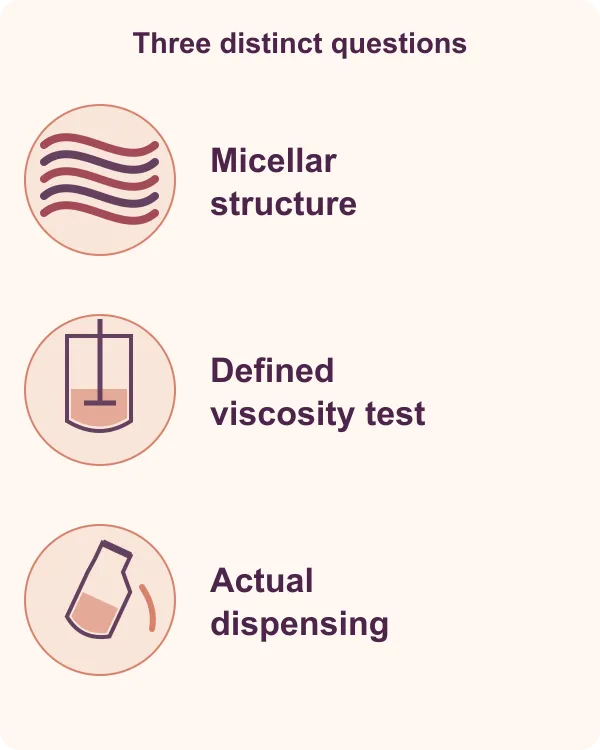
The bulletin uses a rod-micelle model: elongated surfactant aggregates become entangled in solution, increasing viscosity. It also distinguishes additives that promote this structure from selected solubilizing surfactants that help avoid an excessively elastic, non-flowing region. The important distinction is between developing structure and obtaining useful flow. A mixture can become more structured without becoming better suited to its bottle or application.
A raw-material amine value answers a different question. It describes an analytical property of the supplied ingredient under its stated method. Neither it nor the supplied solids content specifies the arrangement of aggregates in a complete acidic mixture. Two trials can use material that meets the same incoming limits and still differ because the rest of the formulation, its concentrations or its preparation history differs.
The qualitative illustration represents this distinction; it is not a microscopy image, a measured concentration sequence or a dose recommendation. Actual flow transitions must be established for the selected ingredients and formulation. Do not interpret a depicted network as a guaranteed structure of a particular commercial grade.
The practical diagnostic question is therefore more precise than “Is the thickener strong enough?” Ask which change moved this particular mixture away from its useful flow region. Check the declared identity and supplied concentration of coingredients before attributing the result to an off-specification thickener. An unexplained difference remains an investigation, not proof of a faulty lot.
Keep the portfolio boundary with the claim
The manufacturer's portfolio includes ethoxylated amines, quaternary ammonium surfactants and amine oxides. Its ethoxylated-amine entry specifies use below pH 5. Other families have different stated application boundaries. The portfolio-wide headline must not be read as evidence that every listed chemistry, or every oleylamine ethoxylate, works across all pH conditions or in every bleaching system.
For a grade enquiry, retain the exact chemistry and application together. A family name can identify a starting point for technical discussion; it does not establish the required ethoxylation distribution, composition, handling conditions or compatibility of the offered grade. Those details need the relevant current grade documents and the supplier's application guidance.
This is also why this article does not propose combining an acid cleaner with a bleaching agent. An entry for another product family is not permission to combine ingredients. Qualified formulation and safety assessment must precede any development work; the source examples do not validate the safety of a proposed mixture.
A change of family is more than a catalogue substitution. Keep a record of what the alternative is intended to change: flow during dispensing, retention on a surface, clarity or another defined property. If the reason for the change is not explicit, a favourable isolated viscosity result can conceal a failure in the property that originally mattered.
Read the viscosity result as a method-dependent observation
The bulletin states its example formulations on a product-as-supplied mass basis. The concentration of an acid stock and the amount of that stock included in a formulation are separate quantities. Likewise, equal masses of two supplied surfactants do not necessarily represent equal amounts of the relevant material. Preserve the original basis before comparing examples; do not silently recalculate them as pure-active recipes.
| Item in a comparison | Information to retain | What it does not establish alone |
|---|---|---|
| Acid stock | Identity and concentration of the supplied stock, separate from its proportion in the mixture | Final acidity, compatibility or a safe mixing procedure |
| Surfactant addition | Exact grade and whether the amount refers to product as supplied or another defined basis | Equal composition or equivalent performance between suppliers |
| Viscosity observation | Instrument and geometry, speed, temperature, sample conditioning and timing | Pouring behaviour over a different range of conditions |
| Application result | Relevant package or surface, contact conditions and the actual acceptance criterion | Cleaning efficacy, substrate compatibility or storage stability unless tested |
The example viscosity label identifies spindle 3 and 30 rpm. It does not provide a complete instrument model, temperature or conditioning protocol. Without the remaining information, the figures are illustrative supplier observations rather than a ready-made acceptance specification. Do not invent the missing conditions or describe the numbers as a full rheological curve.
A rotational speed is not automatically a transferable shear rate across different measuring geometries. For a meaningful comparison, agree the actual equipment, setup and procedure with the laboratory. Where these details are unavailable, describe the limitation rather than ranking small numerical differences. The existing cloud-point guide addresses a different but related problem: a property value cannot be separated from the medium and test conditions.
Decide from a controlled flow comparison
The following is proposed engineering guidance, not a standardized method or a manufacturer-validated universal protocol. Begin with an approved reference formulation and its intended package and application. Define what a useful result means before changing an ingredient: dispensing, spreading or retention, recovery after handling, and any other necessary performance must have their own relevant observations.
Keep the comparison interpretable. Record the complete composition on an explicit basis, the actual raw-material identities and lots, preparation history, conditioning time and temperature. Change one deliberate variable where practical. If several things change together, the trial may reveal a different outcome but cannot reliably assign its cause to one ingredient.
Read the viscosity result alongside the relevant flow observation. A sample that resists pouring calls for investigation even if its single-speed viscosity is high. A readily dispensed sample still needs the intended application checks. Appearance and flow do not establish cleaning, corrosion, material compatibility or long-term stability; those require their own qualified evaluations.
A purchasing decision should preserve the distinction between incoming raw-material acceptance and finished-formula qualification. Request the exact grade documents and the conditions behind any application claim, then agree a sample comparison that addresses the unresolved property. Where the offered composition or measurement basis is unknown, hold that decision rather than borrowing another supplier's result.
For the separate question of acidity versus surfactant assay, see LABSA active matter, free acid and acid value. Further surfactant technical knowledge can provide context; it does not replace grade-specific evidence or safe formulation development.