
A LABSA certificate can contain active matter, free acid and an acid-value or total-acidity result. These are not three interchangeable ways to express surfactant purity. Read the substance being measured, units, calculation convention and method before comparing lots or using the figures in a process specification.
The MOS linear alkylbenzene sulfonic acid Product lists active matter and free acid as separate reference items. The public table does not identify the methods or define the free-acid analyte. That omission must be resolved in the offered-grade documents; it is not permission to rename the row as free sulfuric acid or infer a batch result.
Start with what each result measures
Anionic-active matter concerns the surfactant being assayed. An acid-value or titratable-acidity determination concerns neutralizing capacity under a defined procedure and endpoint. When expressed as mg KOH/g, the acid-value unit describes a mass-equivalent neutralizing requirement per mass of sample, rather than a surfactant mass percentage.
LABSA itself is acidic. A total acidity measurement can therefore include the acid surfactant as well as other contributions within the method's scope. It cannot simply be labelled the amount of unwanted free mineral acid. Conversely, a free-acid result requires its own named analyte and method; the word free does not settle those details.
| COA wording | Establish before comparing | Avoid this shortcut |
|---|---|---|
| Anionic-active matter, % | Analytical method, reporting basis and molecular/equivalent-mass convention | Treating the percentage as the total neutralization requirement |
| Free acid, % | Exact acid species, method, endpoint and whether the result is reported as that species or an equivalent | Assuming every unspecified free-acid row means sulfuric acid |
| Acid value or titratable acidity | Units, titrant/endpoint convention, calculation basis and method applicability | Relabelling acidity as active surfactant or as a free-acid mass fraction |
Two percentages with different analytes are not comparable merely because both use a percent sign. Nor does a unit conversion change the substance that a test measures.
Check the mass convention behind an active percentage
The public scope of ISO 2271 describes anionic-active-matter determination and requires the relative molecular mass of the active material to be known. Its scope also excludes samples containing cationic surfactants. The full applicable laboratory procedure and sample preparation must be agreed; a method number on a quotation is not proof that a particular batch was tested correctly.
The purchasing implication is concrete: converting a measured amount of anionic-active equivalents into a mass percentage needs the declared molecular or equivalent-mass convention. With an appropriate common method, different calculation assumptions can still produce differently reported mass results. Ask the laboratory which convention it used before interpreting a small difference as a change in grade quality.
Stepan's August 2026 BIO-SOFT S-101 bulletin, which supersedes its August 2024 edition, provides a named LABSA example with an explicit equivalent-weight convention beside its active declaration. This illustrates why the convention belongs with the result. It does not establish the chain distribution, active value or composition of a MOS sample.
Keep incoming acceptance separate from neutralization development
For a lot comparison, request the offered grade, sample and lot identities, method revisions, units, reporting conventions and acceptance limits. Compare like analytes using suitably comparable methods. Investigate an apparent discrepancy with the laboratory before rejecting a shipment or silently selecting the more favourable number.
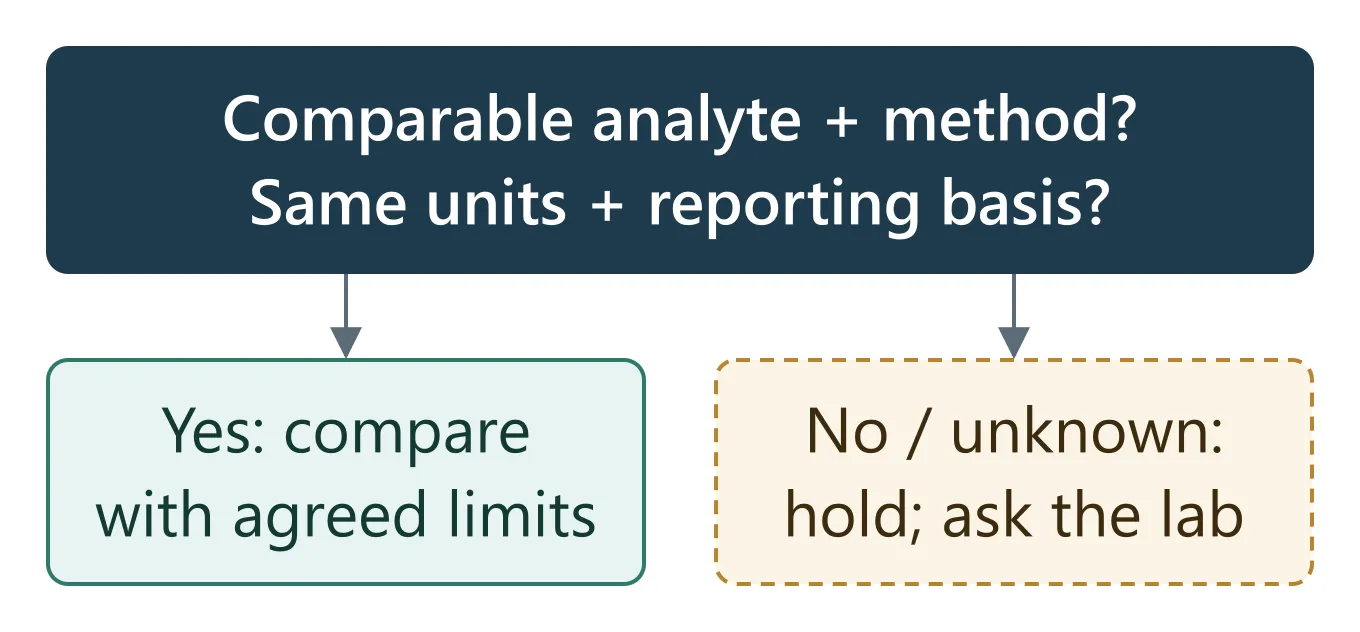
A neutralization plan is a separate process task. It needs the actual acid feedstock and neutralizing agent, their relevant analyses, the target chemistry and the approved process controls. An active-matter percentage alone is not a universal alkali-dose calculation. Stepan explicitly describes its own illustrative neutralization quantities as approximate and shipment-dependent; they must not become a MOS production recipe.
If the method or meaning of a free-acid row is unresolved, hold the corresponding specification decision. Do not compensate by choosing a pH endpoint or a caustic quantity from an unrelated supplier's example. Process validation and safe operating instructions belong to the qualified formulation and production team.
Use the LABSA grade enquiry to request the current TDS/SDS, agreed lot COA, separate active/free-acid methods and the basis needed for your formulation. Include the intended detergent system, process constraints, sample quantity, packaging and destination. For the different question of supplied acid versus sulfate-ether salt, consult the existing SLES versus LABSA process comparison.