

On this page
A D80 solvent offer can include a flash point, a boiling range and an evaporation figure on the same sheet. Those entries are related to the fluid's behavior, but they do not measure the same thing. Selecting a drum from one of them alone can leave the actual cleaning, coating or metalworking requirement unresolved.
The first purchasing task is to establish which product and document are being compared. “D80” is a commercial grade designation, not a complete chemical composition, an application test or a universal guarantee of a particular value. The brand, supplying region, document revision and status of each reported property still matter.
Original AI-assisted editorial illustration of a liquid film on metal, not a MOS sample photograph or a solvent test result.
Read the grade designation in its manufacturer's context
Shell explains the number in its own dearomatized D-grade portfolio as a minimum flash-point designation. That explanation belongs to that portfolio; it should not be extended automatically to every supplier using a similar label.
A concrete countercheck is ExxonMobil's North America Exxsol D80 sales specification, effective 31 May 2024. It lists a flash-point minimum of 77 °C under ASTM D93. That is a stated limit for that named regional product, not a MOS specification and not evidence that every D80 must meet either 77 °C or 80 °C. Keep the current document for the actual offer with the quotation.
Petroleum solvent identities also need more than a familiar CAS number. Shell describes its dearomatized family as mixtures of normal-, iso- and cycloparaffins. A shared petroleum-substance identifier does not establish an identical boiling distribution or a qualified substitute. Ask for the exact commercial identity and relevant composition description rather than treating a mixture as one pure compound with one boiling point.
This is especially important when a quotation changes supplier or region while retaining a short grade name. Before comparing a numerical difference, establish whether the documents describe the same supplied product, different regional specifications or entirely different portfolios.
Separate the three observations
Flash point is a result obtained under a specified ignition-test procedure. It is not the time needed for solvent to leave a coating or a cleaned component. It is also not a recommended operating temperature, a self-ignition temperature or a complete safety classification. Handling and process decisions require the actual grade's current SDS and the responsible site's assessment.
A distillation range describes behavior under the stated distillation method. For a solvent mixture, the initial and final endpoints carry different information; neither endpoint alone describes the whole distribution. ExxonMobil's named North America document reports separate ASTM D86 limits for the initial boiling point and dry point. Those are document-specific limits, not a drying-time prediction.
Relative evaporation is another observation. Its value needs its definition, reference material, scale and test conditions. Shell's D100 technical sheet, for example, gives a relative evaporation entry with n-butyl acetate equal to one under ASTM D3539 as cited in that sheet, separately from its ASTM D86 distillation entries and ASTM D93 flash point. Confirm the method and version applicable to the actual offer rather than assuming a cited method is a current contractual requirement. These are separately labelled typical properties of ShellSol D100. They are not a family-wide specification or a measured MOS result.
| Entry being compared | Retain from the document | It does not establish alone |
|---|---|---|
| Grade name | Manufacturer, exact grade, region and revision | Identical composition or an approved replacement |
| Flash point | Method, reported limit or result, and relevant document status | Application drying time or a safe process setting |
| Distillation range | Initial/final endpoint definitions, method and units | Complete evaporation behavior of an applied film |
| Relative evaporation | Rate or time-index definition, reference, scale and conditions | A comparable value when the other sheet uses a different basis |
| Application observation | Actual formulation, substrate, applied amount, conditions and acceptance criterion | Performance in every process or every supplied batch |
Check the evaporation basis before ranking the numbers
A reference label is part of the result, not a footnote to discard. A sheet that assigns one to n-butyl acetate is not using the same numerical scale as one assigning one hundred to that reference. First establish whether both quantities are rates with the same definition and conditions. A time-based index needs a different interpretation.
For a hypothetical rate-ratio example, 0.2 on a reference-equals-one scale would correspond to 20 on an otherwise identical reference-equals-one-hundred scale. That arithmetic does not describe a particular D80 batch. It illustrates why comparing the printed numbers without their definitions can create an apparent difference where only the scale changed.
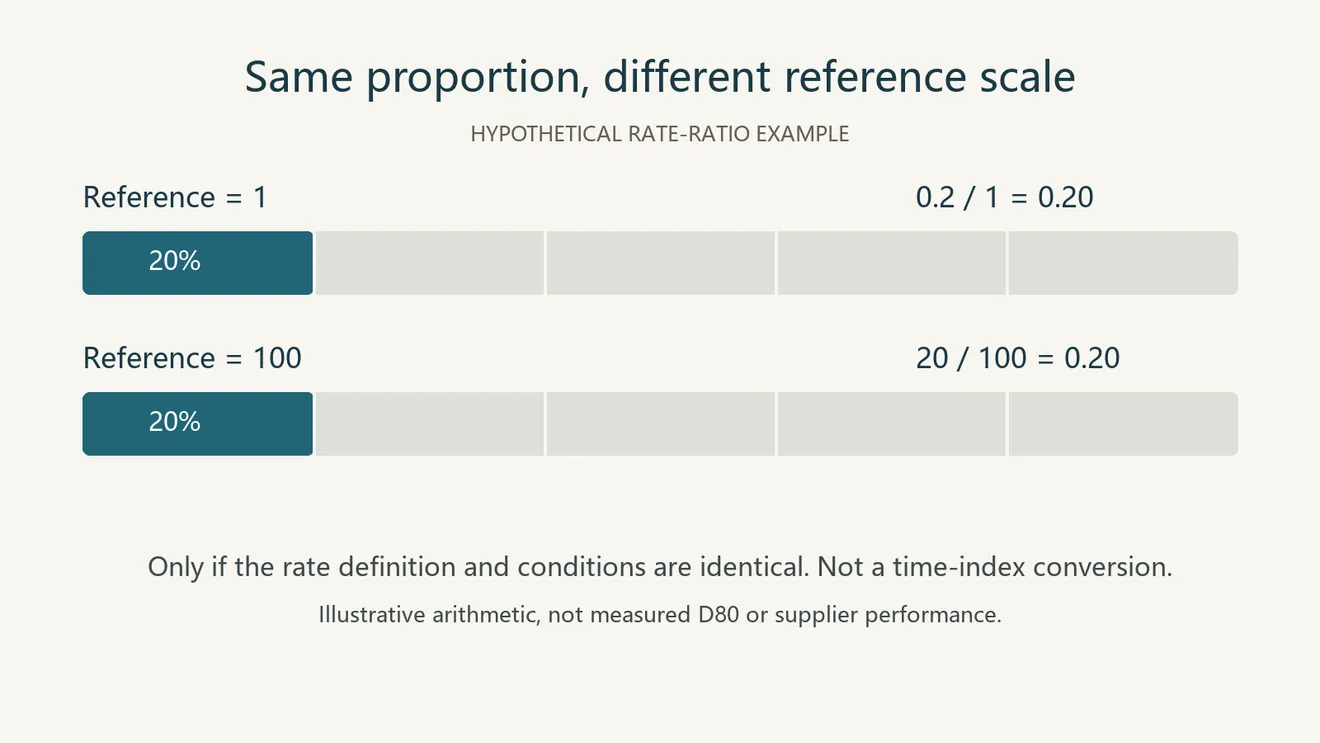
Do not perform that conversion when the method, reference or rate-versus-time definition is unknown. Nor does a valid scale conversion remove differences in temperature, specimen preparation or other measurement conditions. Ask for the missing information before claiming that one candidate evaporates faster.
Keep “typical” separate from a guaranteed limit and from a lot result. A typical-property sheet helps characterize a product. A sales specification states the document's limits. A COA reports results or certification information for the identified supply. They may be useful together, but one should not silently replace another in an acceptance decision.
Take the unresolved question into the application trial
The practical question is often a process outcome: does the proposed fluid leave the component adequately dry, produce an acceptable coating film, or work with the intended material? A comparison of flash-point labels does not answer that question.
Define the outcome and comparison conditions with the technical team before testing candidates. Record the exact grade, complete formulation where relevant, substrate, applied amount or film basis, preparation history, environmental conditions and observation method. Retain a qualified reference when one exists. These are proposed engineering checks, not a universal test protocol or permission to improvise a hazardous drying process.
A solvent change can affect more than disappearance of liquid. Keep the actual cleaning, residue, appearance, compatibility or other acceptance requirement separate. A candidate that appears to dry sooner has not automatically met those requirements. Changing the solvent, application method and formulation together also makes it difficult to assign the cause of a different result.
Where the proposed comparison requires process or safety changes, resolve them through the responsible qualified team and the current SDS. This guide provides no heating setpoint, ventilation design, mixture recipe or approval to substitute a fluid in operating equipment.
Compare offers on the evidence that remains missing
A useful technical enquiry identifies the exact offered grade and region, the unresolved application requirement, and which document or test would answer it. Request the current TDS and SDS, the relevant specification or COA, and the method/reference information behind any evaporation comparison. Identify whether a figure is typical, a limit or an actual result.
The MOS D80 product listing provides a route to a grade-specific document enquiry. It is not evidence that the offered material is equivalent to either manufacturer example above.
If an offer supplies only a grade name and flash point, record the drying or application question as unanswered. Do not fill the gap with another manufacturer's number. Conversely, a different printed value is not automatically evidence of an off-specification product until identity, document status and measurement basis have been reconciled.
The defensible purchasing decision is narrower than choosing the highest flash point or the smallest evaporation number: select the documented grade that has been evaluated against the actual requirement. Further surfactant and formulation technical knowledge can provide context; it does not certify any solvent batch or replacement.