For a surfactant buyer, NORCHEM’s November update puts a possible source of alcohol feedstock on the watch list. The company reported a model installation, laboratory alcohol samples and surfactants made from those samples. A defined commercial grade, a supply specification and repeat batch results are still missing from the public record. Those are the documents that would turn an interesting development into a sourcing option.
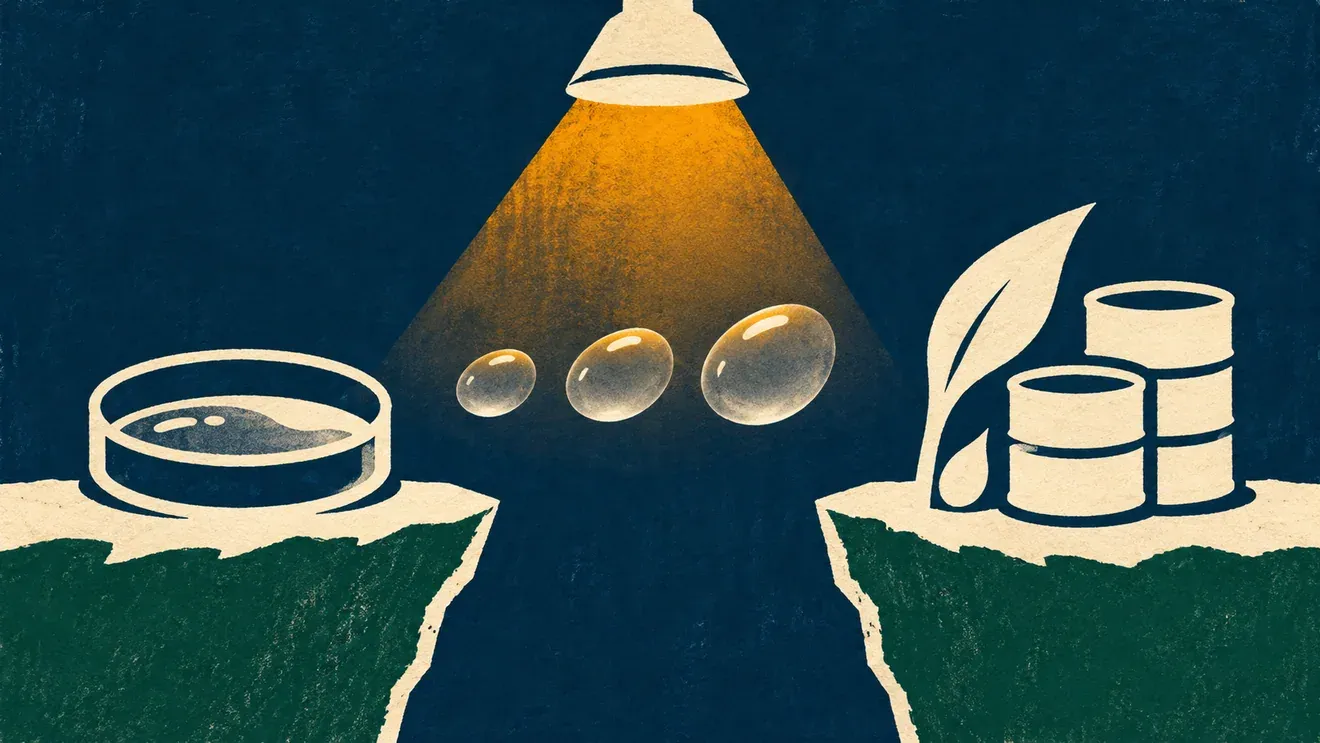
*AI-assisted editorial illustration. It depicts a general idea and does not show the NORCHEM site or samples.*
What NORCHEM reported in November
In an account published on 17 November 2026, NORCHEM described a 10 November discussion at KHIMIA 2026. It said its work with the Topchiev Institute in Dzerzhinsk had produced a model installation and laboratory alcohol samples. The company’s research centre then developed surfactants using the samples. The report describes an industrial pilot installation as the next step. It does not give a capacity, a start-up date or a commercial product specification. Its separate discussion of polyacrylamide production in Saratov concerns a different project.
One detail calls for special care. The NORCHEM report calls them primary unsaturated alcohols. An 11 November public request for proposals, No. 4676734, describes design documentation for a Dzerzhinsk pilot for primary saturated alcohols. Both accounts mention Dzerzhinsk and alkene carbonylation. The two descriptions leave the connection between the projects unconfirmed, including whether they concern the same feedstock, product or installation. Before comparing any proposed material, ask for an unambiguous product identity and its analytical basis. The request for design work gives no evidence that the installation is operational.
Match the evidence to the decision
| Stage or evidence | What it supports for the buyer | What still needs confirmation |
|---|---|---|
| Model installation and laboratory alcohol samples reported by NORCHEM | Monitor development and ask about the intended alcohol profile and application | Product identity, composition range and repeatability |
| Surfactants developed from laboratory samples, as reported | Ask which derivative was evaluated and how the trial was run | Result for the actual derivative in the buyer’s formula |
| A pilot installation described as a next step | Set a milestone for requesting traceable pilot samples | Actual pilot operation, sample availability and lot consistency |
| Commercial offer, if later available | Start supplier and grade qualification with a defined material | Agreed specifications, stable production lots and delivery terms |
Specify both the alcohol and its derivative
Ask for the intended carbon-chain distribution and how it was measured. If relevant to your current formulation, agree how branching, unsaturation and impurities will be reported. A single summary value may help screen a sample, but it cannot show that two materials have the same composition. Keep the identity of the feedstock, the test report and the derivative batch linked.
Then agree what needs to be reproduced in the end use. A result on a derivative made in the developer’s laboratory applies to that sample and test. For a formulation trial, compare an identified derivative with the current reference on a consistent active-matter basis and keep the application conditions fixed. Choose performance checks for the intended job, such as wetting, foam or cleaning under the buyer’s own defined conditions. These are suggested qualification steps and are separate from any results NORCHEM has reported.
Further developments can be followed in surfactant industry news.