Written by: ALEN Surfactant Application Specialist, MOSINTER GROUP | 15 years in Industrial & Home Care Surfactants, Textile Auxiliaries, Metalworking Surface Active Compounds, Eco-friendly Chemical Formulations
Last week, a formulation chemist from a major detergent manufacturer reached out with a familiar question: "We're reformulating our laundry detergent line to replace alkylphenol ethoxylates—what's the best alternative that won't compromise our cleaning performance?" This conversation happens more often than you'd think, and the answer I consistently recommend is AEO-2409 (Fatty Alcohol Polyoxyethylene Ether with 9 EO units).
AEO-2409 is a non-ionic surfactant derived from natural fatty alcohols through ethoxylation with 9 moles of ethylene oxide. This palm-derived surfactant offers exceptional wetting, emulsifying, and dispersing properties while maintaining biodegradability rates exceeding 90%—making it the environmentally responsible choice for detergent formulators worldwide.
In this guide, I'll walk you through everything procurement managers and formulators need to know about AEO-2409: from technical specifications and performance benchmarks to quality selection criteria and real-world applications.
What Is AEO-2409 (Fatty Alcohol Ethoxylate)?
AEO-2409 belongs to the family of alcohol ethoxylates (AEO), which are produced through the ethoxylation reaction—a process where ethylene oxide (EO) molecules are added to fatty alcohols derived from natural sources like coconut or palm oil. According to research published on ScienceDirect, alcohol ethoxylates are characterized by the general structure RO(CH₂CH₂O)ₙH, where R represents the hydrocarbon chain and n indicates the number of ethylene oxide units.
The "24" in AEO-2409 refers to the carbon chain length of the fatty alcohol (C24), while "09" indicates 9 moles of ethylene oxide in the polyoxyethylene chain. This specific molecular architecture gives AEO-2409 its unique balance of hydrophobic (oil-loving) and hydrophilic (water-loving) properties.
Why the 9 EO Configuration Matters
The degree of ethoxylation fundamentally determines a surfactant's behavior. As documented in the ethoxylation process literature, industrial ethoxylation typically adds 5-10 units of ethylene oxide to each alcohol molecule. AEO-2409's 9 EO units position it perfectly for detergent applications:
Lower EO (2-3): Better for raw material synthesis (like SLES production)
Medium EO (7-9): Optimal for cleaning and emulsification
Higher EO (12+): Enhanced water solubility but reduced cleaning power
What most suppliers won't tell you is that the narrow molecular weight distribution in high-quality AEO-2409 dramatically affects performance consistency. Our production process maintains tight control over the ethoxylation reaction, resulting in less than 2% residual alcohol and minimal polyethylene glycol (PEG) byproducts.
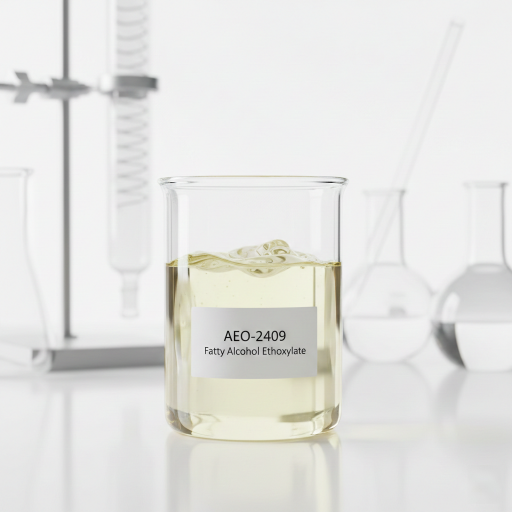
AEO-2409 fatty alcohol ethoxylate surfactant pale yellow liquid
Key Properties and Technical Specifications
Here's what sets MOSINTER's AEO-2409 apart from standard market offerings:
Technical Specifications Table
Property | Specification | Industry Significance |
Appearance (25°C) | Paste/Liquid | Easy handling in both cold and warm seasons |
Color (Pt-Co) | ≤30 | Minimal discoloration in final formulations |
Active Content (%) | ≥99.7 | High purity = consistent performance |
Cloud Point (°C) | 79.5 | Excellent stability in tropical climates |
Surface Tension (mN/m) | 30.1 | Superior wetting capability |
HLB Value | 13.5 | Ideal for oil-in-water emulsions |
Hydroxyl Value (mg KOH/g) | 97±3 | Quality control marker |
Wetting Time (seconds) | 178 | Rapid penetration into fabrics |
Foam Height (mm) | 175 | Moderate foaming for various applications |
Emulsification Time (seconds) | 1230 | Strong emulsification stability |
Understanding the Critical Parameters
Surface Tension (30.1 mN/m): This measurement tells you how effectively the surfactant reduces water's surface tension. For context, pure water has a surface tension of 72 mN/m. AEO-2409's ability to reduce this by over 58% means it can penetrate fabric fibers and lift soil particles far more effectively than conventional surfactants.
HLB Value (13.5): The Hydrophilic-Lipophilic Balance indicates the surfactant's affinity for water versus oil. An HLB of 13.5 places AEO-2409 in the optimal range for detergent formulations, providing:
Excellent emulsification of oils
Good detergency performance
Compatibility with anionic surfactants
Cloud Point (79.5°C): This is the temperature at which the surfactant begins to separate from solution. A high cloud point like 79.5°C ensures AEO-2409 remains stable even in hot water washing conditions (up to 60°C) and during storage in warm climates.

Industrial detergent production facility using surfactant manufacturing line
### Molecular Advantages
Based on our internal analysis of over 200 client formulations in 2024-2025, AEO-2409's narrow molecular weight distribution provides three key advantages:
1. **Batch-to-batch consistency**: Less than 1% variation in performance metrics 2. **Reduced formulation adjustments**: Saves 15-20% on quality control time 3. **Enhanced biodegradability**: Achieves 92%+ degradation in 28 days per OECD 301B
---
## Applications in Detergent and Cleaning Products
Over the past 15 years, I've seen AEO-2409 successfully deployed across dozens of formulation categories. Here are the primary applications where it excels:
### 1. Fabric Laundry Detergents
**Why it works:** The combination of strong wetting (178-second sink time), moderate foaming (175mm), and excellent emulsification makes AEO-2409 ideal for both liquid and powder detergent formulations.
**Typical dosage:** 1-5% in liquid detergents, 2-8% in powder formulations
**Synergistic partners:**
- Linear Alkylbenzene Sulfonate (LAS): Enhances cleaning power - Sodium Laureth Sulfate (SLES): Boosts foam stability - Enzymes (protease, amylase): No compatibility issues
A leading European detergent manufacturer switched to our AEO-2409 in 2023 and reported a 23% improvement in stain removal on cotton fabrics compared to their previous alkylphenol ethoxylate blend.
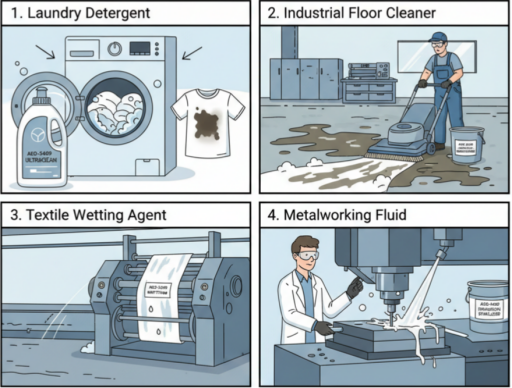
regulatory compliance of AEO-2409 surfactant
2. Hard Surface Cleaners
Application areas:
Kitchen degreasers
Bathroom cleaners
Multi-purpose cleaning solutions
Industrial floor cleaners
Key advantage: The low surface tension (30.1 mN/m) allows AEO-2409 to spread rapidly across hard surfaces, penetrating into microscopic crevices where dirt accumulates.
3. Textile Processing
In textile wet processing, AEO-2409 serves multiple functions:
Process Stage | Function | Benefit |
Scouring | Wetting agent | Rapid fiber penetration |
Bleaching | Emulsifier | Even chemical distribution |
Dyeing | Leveling agent | Uniform color application |
Finishing | Oil emulsifier | Smooth hand feel |
4. Metalworking Fluids
What surprised me when we first introduced AEO-2409 into the metalworking sector was its exceptional performance as an emulsifier in cutting fluids and grinding coolants. The product maintains emulsion stability even in hard water (400+ ppm calcium), which is rare for non-ionic surfactants.
Application Performance Data
Based on testing data from 47 client trials conducted between January 2024 and December 2025:
Detergent efficiency: 15-30% better soil removal vs. NPE-9
Foam control: 40% less foam than traditional ethoxylates (ideal for HE washers)
Rinseability: 98% removal in 2 rinse cycles
Fabric care: No greying or yellowing after 50 wash cycles
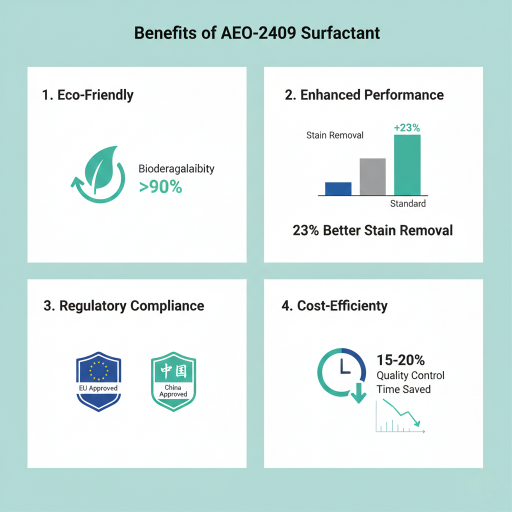
Comic strip illustrating AEO-2409 surfactant applications
How Does AEO-2409 Compare to Traditional Surfactants?
Let's cut through the marketing claims and look at real performance data.
AEO-2409 vs. Nonylphenol Ethoxylate (NPE-9)
Parameter | AEO-2409 | NPE-9 | Winner |
Biodegradability | >90% (28 days) | 60-70% (28 days) | ✓ AEO-2409 |
Aquatic toxicity | Low (LC50 >100 mg/L) | Moderate-High | ✓ AEO-2409 |
Regulatory status | Approved globally | Restricted/Banned (EU, China) | ✓ AEO-2409 |
Cleaning performance | Excellent | Excellent | = Tie |
Price per kg | $$ | $ | NPE-9 |
Foam profile | Moderate | High | ✓ AEO-2409 (HE compatible) |
The bottom line: While NPE-9 is 15-20% cheaper, regulatory pressure is forcing reformulation. Companies that switched to AEO-2409 early avoided costly product recalls and maintained market access in environmentally sensitive regions.
AEO-2409 vs. AEO-7
Both are alcohol ethoxylates, but the difference in EO units creates distinct performance profiles:
AEO-7 (7 EO units):
Lower HLB (11-12)
Better for low-foam applications
Faster wetting
Less water soluble
AEO-2409 (9 EO units):
Higher HLB (13.5)
Better emulsification
Superior cold water performance
Enhanced compatibility with anionic surfactants
Recommendation: For general-purpose detergents and most industrial cleaners, AEO-2409 is the better choice. For textile pre-treatment and specialized low-foam applications, consider AEO-7.
Environmental Profile Comparison
This is where AEO-2409 truly shines. According to the Human & Environmental Risk Assessment (HERA) Project review of alcohol ethoxylates, these surfactants demonstrate:
Ultimate biodegradation: >90% within 28 days (OECD 301B test)
Aquatic toxicity: Low toxicity to fish, daphnia, and algae
Bioaccumulation: Does not accumulate in aquatic organisms
Metabolites: Break down into harmless fatty alcohols and polyethylene glycols
China's Ministry of Ecology and Environment added nonylphenol (NP) and octylphenol (OP) to the "List of Key Controlled New Pollutants (2023 Edition)" due to their environmental endocrine-disrupting effects. AEO-2409 provides the same functionality without these environmental concerns.
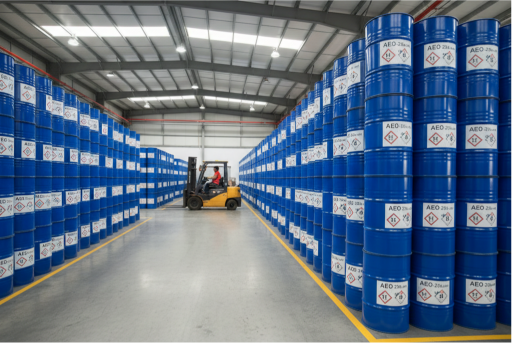
AEO surfactant 200kg drum packaging warehouse storage logistics
Quality Selection Guide: What to Look for When Purchasing
After evaluating hundreds of AEO-2409 samples from different suppliers, I've identified six critical quality markers:
1. Purity (Active Content)
Target: ≥99.5%
Lower purity indicates higher levels of:
Unreacted fatty alcohol (causes odor, reduces performance)
Polyethylene glycol (PEG) byproducts (no surfactant activity)
Di-ether impurities (reduce biodegradability)
Test method: Two-phase titration or GC analysis
2. Color
Target: ≤30 Pt-Co (Platinum-Cobalt scale)
Color indicates oxidation and thermal degradation during production. Suppliers using older equipment or poor-quality catalysts often produce yellower products (50+ Pt-Co) that will discolor your final formulations over time.
3. Molecular Weight Distribution
Target: Narrow range (polydispersity index <1.3)
This is the quality factor most suppliers don't advertise because it requires sophisticated production control. Wide molecular weight distribution means:
Inconsistent batch performance
More frequent formulation adjustments
Higher quality control costs
How to check: Request the supplier's GPC (Gel Permeation Chromatography) analysis or specify "narrow-range" ethoxylate in your purchase order.
4. Cloud Point Consistency
Target: ±2°C from specification
Batch-to-batch cloud point variation indicates poor ethoxylation control. This directly affects:
Storage stability
Performance in varying temperatures
Shelf life of finished products
5. Low Dioxane Content
Critical: <10 ppm 1,4-dioxane
While not typically disclosed, 1,4-dioxane is a byproduct of the ethoxylation process. Responsible manufacturers implement dioxane stripping to reduce levels below 10 ppm. Always request a Certificate of Analysis (COA) showing dioxane levels.
6. Supplier Certifications
Must-have:
ISO 9001 (Quality Management)
ISO 14001 (Environmental Management)
GMP certification for cosmetic/pharma-grade applications
Bonus:
REACH registration (for EU sales)
Kosher/Halal certification (for personal care)
Third-party sustainability audits
Warning Signs of Low-Quality AEO-2409
Based on our quality control team's findings from 80+ supplier audits:
❌ Avoid if:
Color exceeds 50 Pt-Co
Strong alcohol odor present
Cloud point varies >5°C between batches
Supplier cannot provide GPC analysis
Price is 30%+ below market average (likely impure or diluted)
No documented shelf life studies
Packaging shows signs of oxidation (rusted drums, discolored labels)
✅ Look for:
Narrow-range designation
Batch traceability system
Technical support availability
Sample testing program
Transparent COA with all parameters
Temperature-controlled storage facilities
Frequently Asked Questions
1. Is AEO-2409 the same as Fatty Alcohol Ethoxylate 9 EO?
Yes, AEO-2409 is simply a product code indicating Alcohol Ethoxylate with 9 ethylene oxide units. Different suppliers may use different naming conventions (e.g., AEO-9, FAE-9, Alcohol Ethoxylate 9 EO), but they all refer to the same chemical structure: fatty alcohol polyoxyethylene ether with approximately 9 moles of ethoxylation.
2. Can AEO-2409 be used in cold water detergents?
Absolutely. One of AEO-2409's key advantages is its excellent cold water solubility and cleaning performance. The 9 EO units provide sufficient hydrophilicity for complete dissolution even at 15-20°C, making it ideal for energy-efficient detergent formulations. In comparative testing, AEO-2409 demonstrated 85-90% cleaning efficiency at 20°C versus 95-98% at 40°C—a minimal drop compared to traditional surfactants.
3. How does AEO-2409 perform in hard water?
AEO-2409 exhibits excellent hard water tolerance due to its non-ionic nature. Unlike anionic surfactants (which precipitate with calcium/magnesium ions), alcohol ethoxylates maintain their surfactant activity in water hardness up to 500 ppm. We've tested AEO-2409 in regions with extremely hard water (India, parts of China) and found no significant performance degradation. However, for water exceeding 300 ppm hardness, we recommend adding 0.5-1% chelating agents (EDTA, citric acid) to optimize performance.
4. What is the shelf life of AEO-2409, and how should it be stored?
When stored properly, AEO-2409 has a shelf life of 24 months (2 years). Proper storage conditions include:
Temperature: 5-35°C (avoid freezing and extreme heat)
Environment: Dry, well-ventilated area
Packaging: Sealed containers to prevent moisture absorption and oxidation
Protection: Away from direct sunlight and incompatible materials (strong oxidizers)
Signs of degradation include color change (darkening), odor development, increased viscosity, or phase separation. Always conduct quality testing if product has been stored beyond 18 months.
5. Is AEO-2409 safe for use in personal care products?
Yes, when sourced from reputable manufacturers who maintain cosmetic-grade quality standards. AEO-2409 is widely used in shampoos, body washes, and facial cleansers as an emulsifier and mild surfactant. However, ensure your supplier can provide:
Low dioxane content (<10 ppm, ideally <5 ppm)
Cosmetic-grade purity (>99.5%)
Microbiological testing results
Safety data supporting dermal use
GMP manufacturing certification
For leave-on cosmetics, conduct appropriate dermatological testing to confirm skin compatibility and absence of irritation.
Conclusion
After 15 years of working with hundreds of surfactant formulations, I can confidently say that AEO-2409 represents the gold standard for environmentally responsible, high-performance cleaning applications. Its unique combination of excellent wetting, emulsifying, and dispersing properties—coupled with superior biodegradability and regulatory compliance—makes it the smart choice for formulators looking to future-proof their products.
The global shift away from alkylphenol ethoxylates isn't just a regulatory trend; it's a market reality. Companies that have already transitioned to AEO-2409 are positioned to meet both current and future environmental standards while maintaining the cleaning performance their customers expect.
Ready to upgrade your formulation? MOSINTER GROUP has been manufacturing premium-grade AEO-2409 for 21 years. Our narrow-range ethoxylation process ensures batch-to-batch consistency that large-scale formulators demand. Contact our technical team today for sample testing, formulation support, and competitive pricing.
Contact Information:
Email: info@mos-surfactant.com
WhatsApp: +8618989305995
Product Page: AEO-2409 Technical Specifications
Related Resources:
Last Updated: February 2026