
No. A bead pattern is evidence about the appearance of water on a surface under the conditions observed. It does not, by itself, measure how much liquid water enters a coating/substrate system. The same formulation change may affect both, but one observation cannot stand in for the other result.
For a hydrophobing-additive purchase, this is a practical distinction: decide whether the acceptance question concerns surface wetting, liquid-water uptake, or both before choosing the evidence used to approve a sample.
Read beading as a surface observation
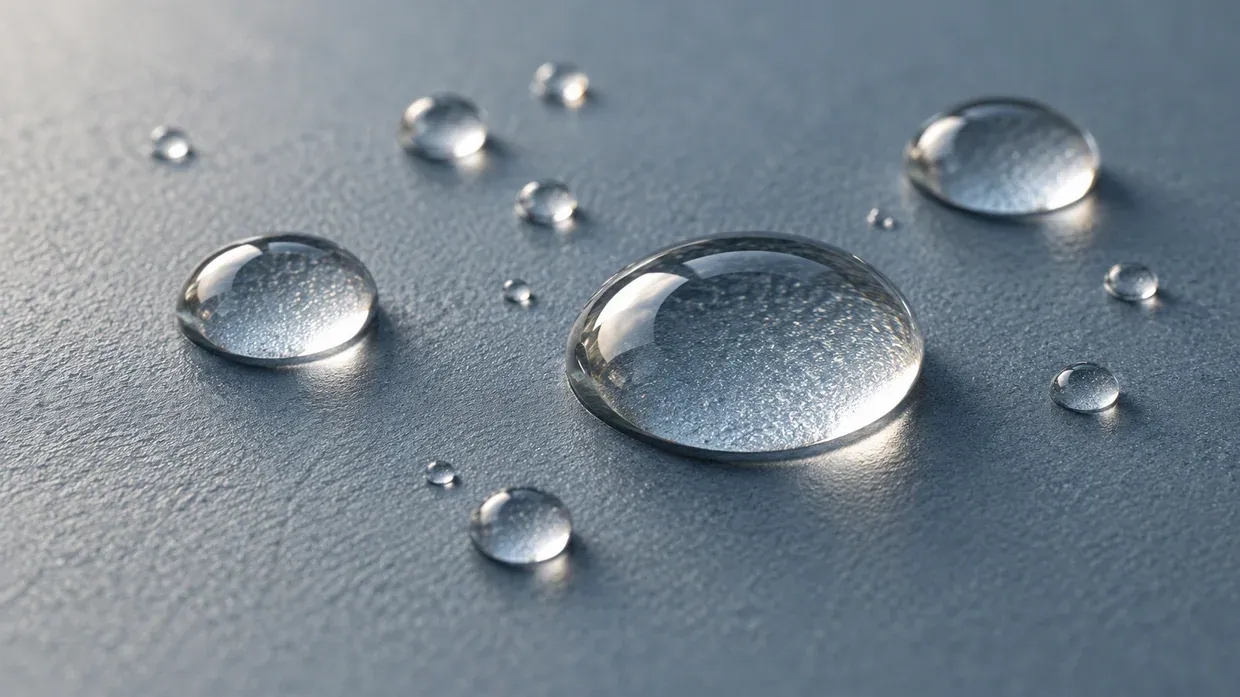
A photograph can show the visible distribution and shape of droplets. Without a defined procedure, it does not establish a contact-angle value, and it cannot reveal water that has entered the coating or the substrate. Retain how the surface was prepared, conditioned and observed when comparing images; an attractive isolated photograph has no matched baseline.
A reported contact angle is a more specifically defined surface-wetting result, but it still needs its measurement conditions. It is not a water-uptake measurement. The distinction is between endpoints, not a claim that surface chemistry and water ingress are unrelated.
The illustration here deliberately supplies no coating grade, substrate identity, angle or uptake value. It helps identify the observation being discussed; it is not a MOS additive test or a before-and-after result.
Choose the uptake test for the substrate
The method must fit the real coated system. The public scope of BS EN 1062-3:2008 concerns liquid-water permeability of coatings for exterior masonry and concrete. That scope should not be carried over unchanged to wood, metal or an unspecified free film.
| Evidence | Question it can address | Limit to retain |
|---|---|---|
| Beading photograph or stated visual observation | What water looks like on the surface in the recorded observation | Does not establish an angle, absorbed quantity or permeability rating |
| Method-qualified contact-angle result | Surface wetting under the stated measurement conditions | Does not replace an uptake test for the coating/substrate system |
| Application-appropriate liquid-water uptake result | Water ingress under the method's specimen, conditioning and exposure basis | Does not automatically qualify other substrates, film builds or end uses |
Agree the method and the required result with the responsible testing party before the comparison. A method name without its applicable specimen and reporting basis is not enough to make two supplier results comparable. This guide uses the public scope, not an invented procedure or a universal acceptance threshold.
Evonik's technical paper on a silicone resin for facade coatings discusses water absorption in a particular coating system. Its formulation, grade and results belong to that study. They are not results for TEGO® Phobe 1505 or for a proposed MOS customer's paint.
Compare matched coating systems
Build the comparison around an identified reference formulation and the candidate change. Record the base formulation and additive identity, the stated addition basis, substrate and preparation, application and film-build basis, curing/conditioning, and the agreed observation or exposure method. Change one defined factor at a time where the comparison permits it.
Keep separate records for beading and uptake. If the surface appearance improves while the required uptake endpoint is unresolved, report exactly that. If an uptake result improves but the appearance is different, judge each against its own agreed requirement rather than declaring one photograph the overall winner.
Also check that the reference and candidate were assessed at comparable states. Different conditioning, substrates or film builds can make a comparison inconclusive even when the additive identities are correctly recorded. A repeat under the agreed basis is more useful than assigning the difference to the additive without a control.
The decision can then be specific: the candidate meets the stated surface criterion, the stated uptake criterion, both, or neither; or the evidence is not yet comparable. These outcomes do not establish a general exterior lifetime or a water-vapour performance rating.
Keep the grade claim attached to its evidence
MOS's Evonik portfolio includes TEGO® Phobe 1505. Ask for the current offered-grade documents and an evaluation basis for the actual coating system. A short catalogue description or another Phobe grade's paper should not be used as that grade's test report.
An enquiry that names the substrate, coating type, reference formulation, required endpoint and proposed sample quantity gives the supplier a defined technical question. Packaging and destination then complete the commercial request. The useful buying outcome is a traceable, application-matched comparison rather than an unsupported claim that “good beads” prove low water absorption.