
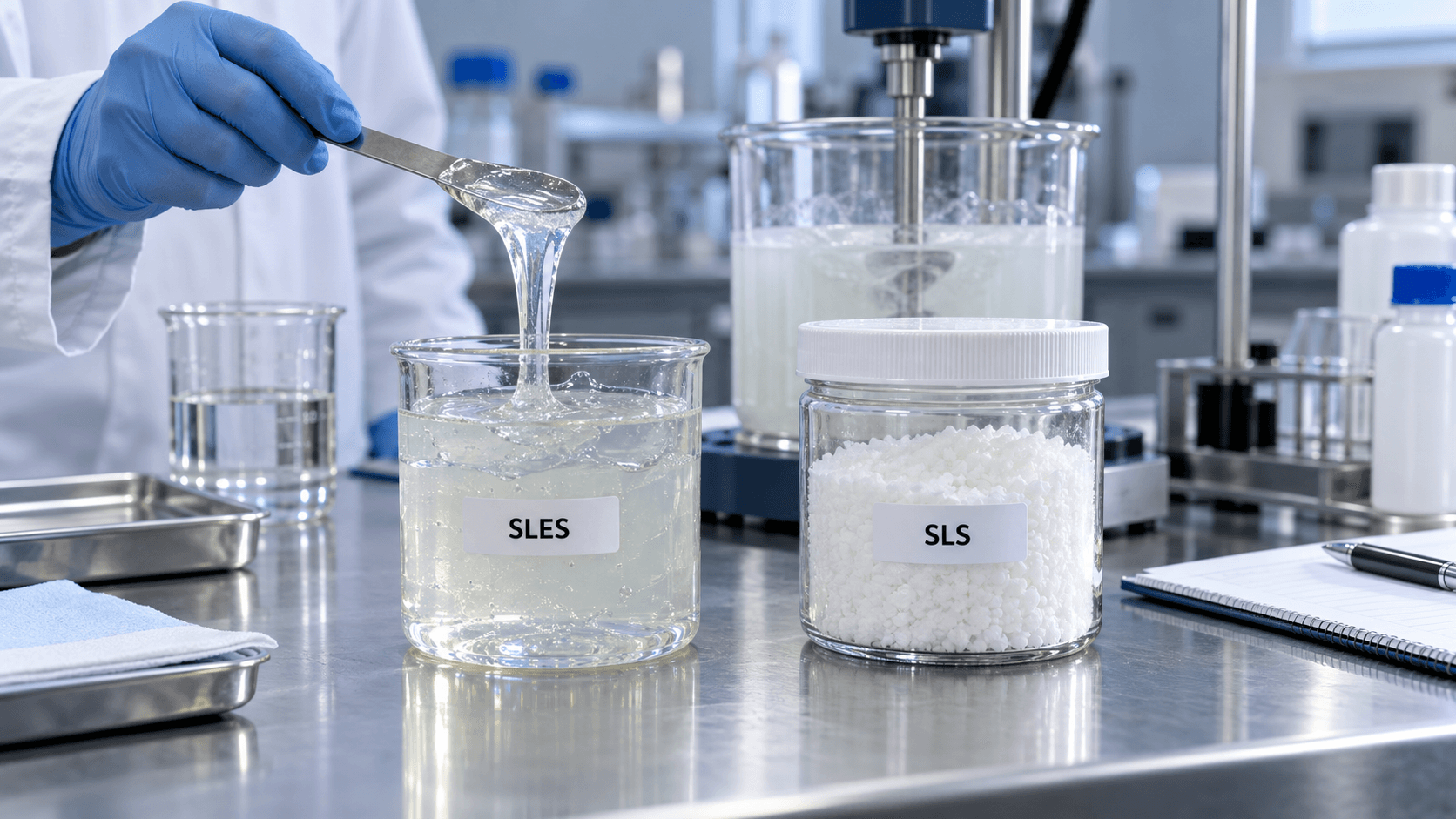
Sodium laureth sulfate (SLES) is an ethoxylated alkyl ether sulfate; sodium lauryl sulfate (SLS) is an alkyl sulfate without that ethoxy chain. Both are anionic surfactants, but a switch changes the formulation as well as the purchasing specification. For detergent and personal-care factories, a useful SLES vs SLS comparison covers the offered grade, active matter, processing, finished-formula performance and delivered cost per unit of active material.
Chemical identity and supplied form
The SLES grade specifications list a paste with active matter of 70.0 ± 2.0%. The separate SLS grade specifications include a K12/30 liquid at ≥30% active matter and a needle grade at ≥92%. These are catalogue specifications for identified grades, not universal concentrations for the two chemicals. Confirm the exact grade code, supplied form and batch result before calculating the formulation charge. For powder offers, obtain a grade-specific sheet rather than assuming every powder entry has the same limits.
Active matter basis and delivered usable material
Compare active surfactant mass on the same basis: delivered mass multiplied by active matter fraction. For a screening cost comparison, divide delivered cost per unit product mass by that fraction. State whether you used a guaranteed minimum or an actual batch result. Keep conversion, handling and formulation costs separate; an active-matter calculation alone cannot identify the better-performing formula.
Supplied form changes the production trial
A concentrated paste, liquid and solid require different charging and dissolution arrangements. Check the plant's transfer and mixing capability, the intended dilution procedure and the time needed to obtain a uniform batch. Confirm handling and storage instructions in the grade documents. Do not assign one packaging or processing procedure to every SLS/SLES grade.
Formulation trials: replacement is reformulation, not a drop-in change
Start comparative bench trials at equal active matter, with the remaining formula and test conditions documented. Compare soil removal, foam behavior, clarity, rheology and storage stability against agreed targets. Then optimize the candidate formula and repeat the tests before a pilot batch. Equal active matter is a comparison basis, not proof of equal performance or equal required dosage. Neither acronym alone establishes mildness or suitability for a finished personal-care product.
Documentation and grade selection
The MOS SLES catalogue distinguishes standard and low-dioxane grades, listing residual 1,4-dioxane limits of ≤70 ppm and ≤10 ppm respectively. Treat these as offered grade limits, not a regulatory conclusion or a finished-product safety claim. Request the current specification, batch COA and test method. Preserve measurement conditions when comparing pH or color, and request the relevant grade-specific quality criteria for SLS rather than copying the SLES checklist.
RFQ checklist: what to include
- Application and current surfactant product, grade and formulation limitation.
- Candidate grade, supplied form, active-matter requirement and agreed residual-component limits.
- Trial formula context and required cleaning, foam, clarity and storage results.
- Sample quantity, first-order and annual demand, desired packaging and destination.
- Required TDS, SDS, batch COA and test-method information.
Request a specification-matched quotation
Send the RFQ details through the SLES product page, identifying the SLS grade being benchmarked if this is a replacement project. Request separate grade documents and sample offers so R&D can approve the formulation before procurement commits to bulk supply.
FAQ
Are SLES and SLS the same ingredient?
No. SLES contains an ethoxy chain in its alkyl ether sulfate structure; SLS does not. Specify the chemical identity and commercial grade separately.
Can I replace SLES with the same weight of SLS?
Not on that basis alone. Offered concentrations differ. Calculate equal-active starting levels, then validate and optimize the full formulation.
Is SLES always milder than SLS?
A finished-product claim cannot be made from the ingredient acronym alone. Concentration, other ingredients and the intended application require formulation-specific evaluation.
How should I compare quotations?
Use the same grade and delivered basis, calculate the cost per unit of active matter, and separately account for handling and formulation performance. Request a COA and current grade specification.